The “unisex” label on a bottle or perfume decant doesn’t describe a distinct chemical composition, but rather how the perfume house chose to sell it and whom it addressed from the time of its launch. Behind it are mainly marketing decisions and a certain olfactory tradition, not an objective property of the smell: there’s no molecule that’s “for men” or “for women,” but notes that the public has learned over time to associate with a particular gender. When you understand where this convention comes from, you can choose a perfume based on how it smells on your skin, not on the picture on the box, and a small decant lets you test the idea without buying a whole bottle at once.
- “Unisex” is first and foremost a historical and marketing convention: it has changed several times over the last century as perfume-selling habits have changed.
- A few note families—woody (sandalwood, cedar, vetiver), synthetic musk used as a base and, to a lesser extent, leather—tend to be perceived as more neutral than sweet floral or strongly aromatic “masculine” notes.
- Eight perfumes from our catalog illustrate different directions built around these notes, from woody-smoky to gourmand-powdery.
- To test a perfume together, a 2 or 3 ml decant for each person usually tells you more than the label on the box.
What the “unisex” label on a perfume really means
The divide we see today between “women’s perfume” and “men’s perfume” historically arose mainly from the concentration of aromatic compounds used, not from the notes themselves: versions sold to women often had higher concentrations, sold as “perfume” or eau de parfum, while those for men more often appeared as eau de toilette or eau de cologne, more diluted versions (source: Perfume — Wikipedia). The first “colognes,” the ancestors of many perfumes today, were largely citrus blends without any particular “parent perfume,” so they were worn by anyone, with no connection to the buyer’s gender—they were explicitly described as unisex even then (source: Perfume — Wikipedia).
The boundary shifted again towards the end of the 1980s, with the arrival of the aquatic or ozonic family, built around synthetic materials such as calone: many perfumes in this family were sold and perceived as androgynous, intended equally for women and men (source: Perfume — Wikipedia). In other words, what we call “unisex” today isn’t a fixed category of smells, but the result of several waves of commercial decisions and changing tastes. That doesn’t mean the label is meaningless—it usually tells you which audience the perfume house had in mind at launch—but simply that you shouldn’t read it as a strict chemical rule about what you can or can’t wear.
Notes that smell more neutral: sandalwood, leather, musk, vetiver, linden
If you look at perfumes often called unisex, one group of materials appears again and again. The woody family is built around sandalwood, cedar, vetiver and agarwood (patchouli often appears alongside them), materials that have long been used both in compositions traditionally designed “for men” and in those designed “for women”—making them a natural starting point for any perfume that aims to avoid a clearly gendered direction (source: Perfume — Wikipedia). Synthetic musk plays a different role: most often, it works as a subtle base beneath the middle notes, rather than as a “gendered” note in its own right, so its presence tends to smooth a perfume out rather than push it in a particular direction (source: Perfume — Wikipedia).
Leather and linden work similarly, based on observation: leather brings a rougher, less sweet texture that cuts through the floral side without becoming aggressive, while linden (tilleul) remains a green, powdery note, subtle enough that we don’t instinctively associate it with a gender. There’s no published external source we can cite here for these two notes; these remain descriptions of perception, not independently verified facts, and we treat them as such.
Eight unisex perfumes from our catalog built around these notes
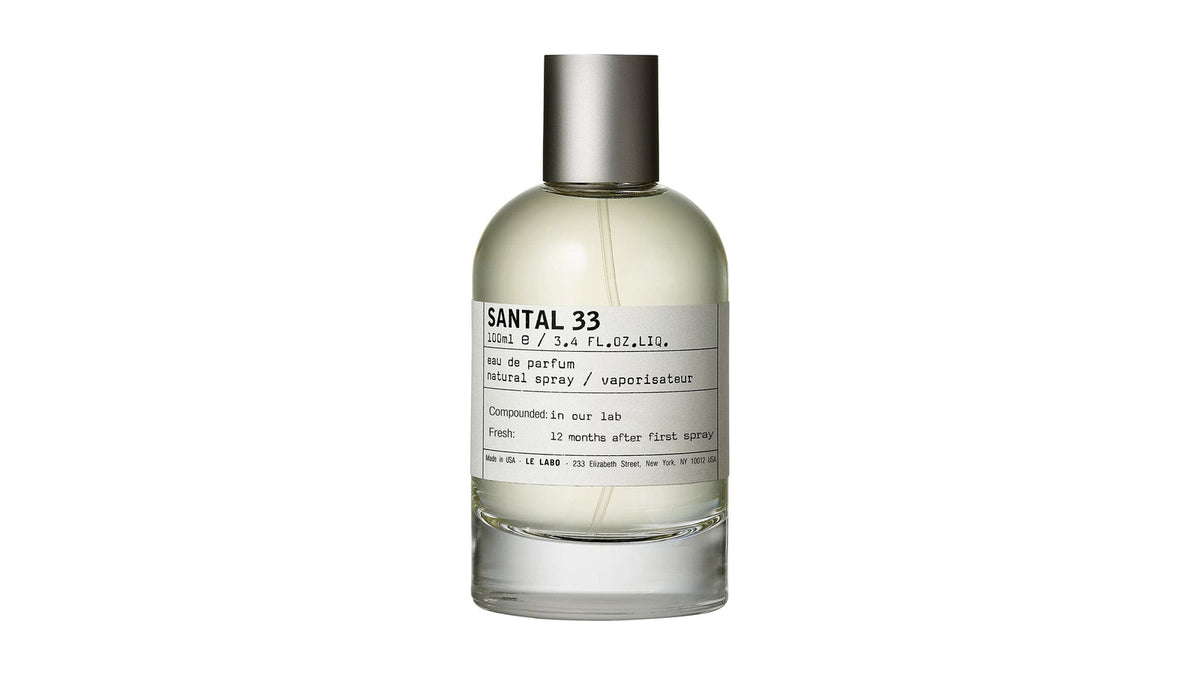
Among those explicitly built around woody-sandalwood notes, Le Labo Santal 33 is the most direct reference point. According to the product description, Australian sandalwood is dry and lightly smoky, with cardamom and violet at the opening, followed by iris, ambrox and papyrus at the heart, while the base brings cedar and leather; it’s a niche Eau de Parfum, launched in 2011 and created by perfumer Frank Voelkl.

Marc-Antoine Barrois Ganymede, positioned in the niche segment and included in our catalog’s unisex collection, follows the same woody path, as does Tom Ford Ombré Leather, built visibly around the leather note that also gives the perfume its name. For both, we don’t yet have a note pyramid confirmed by an independent source, so we present them in terms of positioning—the house, category and place in the unisex collection—and not with invented note-by-note details.
Byredo Bal d'Afrique follows the same logic, from a Swedish niche house known for minimalist compositions, while Xerjoff Erba Pura comes from an Italian luxury house founded in Turin in 2007 by Sergio Momo and Dominique Salvo, which also revived the historic Casamorati house in 2009 (source: Xerjoff — Wikipedia). Amouage Guidance has a different story behind it: the house was founded in Oman in 1983, with a distinctive visual identity—the cap on the women’s bottles inspired by the dome of a mosque, and the cap on the men’s bottles by the handle of the ceremonial Omani khanjar (source: Amouage — Wikipedia).
For anyone looking for a gourmand direction rather than a woody one, Matière Première Vanilla Powder remains a frequently requested choice from the unisex collection; if sweet notes interest you more than gender labels, we’ve written about them in detail in our guide to sweet perfumes in the catalog. And among the truly well-known references, Maison Francis Kurkdjian Baccarat Rouge 540 has a well-documented story: it was created by Francis Kurkdjian for the crystal house Baccarat, launched in January 2016, with publicly listed notes of hedione, ambroxan, cedar and saffron, and has since become one of the best-selling niche perfumes in Europe and the United States (source: Baccarat Rouge 540 — Wikipedia). All eight are part of the catalog’s Unisex collection, where you’ll find other options too if none of these feels right to you straight away.
How to choose where to start, together
If you both want to start with the same perfume, the simplest thing is not to buy a whole bottle right away. A 2 or 3 ml decant is enough for several good days of wearing it on your own skin—enough to work out whether it’s worth getting a larger decant or a full bottle, without the risk of an unfinished bottle in the cupboard. You’ll find the exact sizes and the number of sprays you get from each size in our size guide.
Testing it separately on each person’s skin usually matters more than the label on the box: skin temperature, its level of hydration and even what you used beforehand can change how intensely and for how long the same perfume lasts on you compared with your partner. We go into more detail on this in our article on why the same perfume smells different from one person to another, and if you’ve just chosen a decant to try, our guide to where to apply perfume and how many sprays are enough can help you avoid overdoing it on your first try. If you want a starting point that many consider wearable by anyone in the household, Santal 33 remains a common reference point from which to start comparing the other seven in this guide, while the rest of the perfume discussions in Perfume Guides can help with the next step, once you’ve decided which note family you want to explore further.